



Scientists in Australia have discovered that vinegar kills Crown-of-Thorns Starfish just as effectively as the current drug, which can be expensive and difficult to source.
Outbreaks of the venomous Crown-of-Thorns Starfish (Acanthaster planci) pose one of the most significant threats to the Great Barrier Reef.
Researcher Lisa Boström-Einarsson said vinegar had been tried unsuccessfully before, but James Cook University scientists refined the process which resulted in a 100% kill rate.
Ms Boström-Einarsson said the findings were exciting. “Currently divers use 10 or 12 ml of ox-bile to kill each Crown-of-Thorns Starfish (COTS). It’s expensive, requires permits and has to be mixed to the right concentration. We used 20 ml of vinegar, which is half the price and can be bought off the shelf at any local supermarket.”

“It has been estimated there are between 4 and 12 million of the starfish on the Great Barrier Reef alone and each female produce around 65 million eggs in a single breeding season. They managed to kill around 350 000 last year with two full-time boat crews. While it would take an insane effort to cull them all that way, we know that sustained efforts can save individual reefs,” Ms Boström-Einarsson commented.
She said other researchers were working on population-level controls of the animal, but killing the starfish one-by-one was the only method available at the moment.
Starfish-Killing Robots also to be Unleashed
At the Queensland University of Technology they are investigating an alternative method for killing the starfish – robots. Called a COTSbot, it is designed to search the reef for up to eight hours at a time, delivering more than 200 lethal shots.
Its creator, Dr Matthew Dunbabin, says the COTSbot is equipped with stereoscopic cameras to give it depth perception, five thrusters to maintain stability, GPS and pitch-and-roll sensors and a unique pneumatic injection arm to deliver a fatal dose of bile salts.
If the robot is unsure that something is actually a crown-of-thorns starfish, it takes a photo of the object to be later verified by a person, and that human feedback is incorporated into the robot’s memory bank.
The COTSbot is planned to be working the reef autonomously in December.
Why are Crown-of-Thorns Starfish such a Problem?
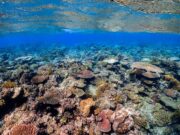
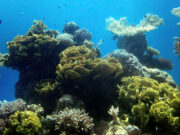
Infestations are a major cause of damage to coral reefs around the world. The starfish feed on live coral, especially Acropora. Normally Acanthaster is uncommon and doesn’t do much damage, but when a population explodes it can advance across a the reef leaving behind a mass of dead, white, corals. Other species that depend on the coral for food and shelter then disappear.

Why do populations of Crown-of-Thorns Starfish explode? One contributory factor might be the removal of its predators. It doesn’t have many but Triton’s trumpet, the Harlequin shrimp and Napoleon wrasse all feed on the starfish. Triton’s trumpet in particular has been over-collected for its shell. Taken together nutrients being washed off the land into the reef after torrential rain, which boosts the growth of the COTS larvae, means conditions are perfect for the starfish. Studies have shown that plagues of Crown-of-Thorns Starfish have in the past occurred around every 400 years. But now, especially in areas of runoff, the frequency has increased dramatically.


